Handmade Furniture: A Practical Guide to DIY Projects for HDB Apartments in Singapore
HDB flats in Singapore rarely offer spare square metres: typical 2- and 3-room layouts often sit in the range of about 40–65 m², and the kitchen, bedroom, and living area must coexist without unnecessary corridors. Ready-made furniture from shopping galleries is designed for a “typical” apartment and continental standard dimensions; in a local wall layout you get narrow alcoves, angles by windows, and limited lift door width. Building furniture yourself lets you match every centimetre to the actual floor plan, and with a little joinery experience you can genuinely reduce the cost of fitting out the bedroom and workspace.
Working inside a flat takes discipline: MDF cutting dust is best contained with a wet/dry vacuum and cutting on the balcony in line with estate rules, and noise should be scheduled for hours allowed by the management. In return you avoid installation queues, you know every screw, and later you can replace one module instead of throwing away an entire set — which matters in a city with high disposal costs.
Why Build Your Own Furniture in Singapore
The first argument is budget. A Murphy bed with a professional gas mechanism and a made-to-measure front often costs in showrooms from about 4000 to 8000 S$, including installation and transport. A DIY kit based on marine plywood, a proven lift mechanism (e.g. heavy-duty systems from makers such as Sugatsune or similar hardware available at local fitting shops) and your own structural timber frame can usually be kept within roughly 500–1500 S$ if you already own basic tools. The second advantage is dimensions: HDB walls, ceiling height (often about 2.6 m in older blocks, slightly more in BTO), and passage width from the stairwell vary between flat series — furniture cut from board on site fills the alcove without gaps and does not block the storeroom door.
The third factor is climate. Relative humidity in Singapore stays for most of the year between about 70% and 90% (MSS climate data), and the temperature rarely drops below 24–25 °C. Material that “moves” seasonally in Europe here is constantly exposed to moisture from the air. In DIY it pays to choose stainless steel (A2/AISI 304) fittings instead of ordinary galvanised steel where they meet kitchen moisture, and to protect timber with polyurethane lacquer or film-forming oil — not only for looks but also to limit warping.
Before cutting load-bearing walls or fixing heavy elements to concrete, read the official HDB renovation guidelines on building works and contractor approval — the HDB renovation guidelines page collects rules you must follow whether you install the furniture yourself or with a firm on the registered contractors list.
Wall-Mounted Folding Table — Step by Step
A wall-mounted table works well in the kitchen of a 3-room HDB, where the worktop area is often 5–8 m² and there is no room for a permanent four-person table. The goal is a worktop about 75–90 cm wide and 45–55 cm deep when extended; folded, the top sits vertically against the wall and frees the walkway.
Material: marine plywood of at least BS 1088 grade or equivalent (18 mm thickness) for the top; a reinforcing strip along the long edge that is hinged. Hinges: at least two heavy stainless steel angle hinges (e.g. “flip” / 90° table lift type with a declared load of 40–60 kg per pair — choose according to the weight of the painted top). Anchors: expansion plugs for concrete or a screw-type drywall bracket with a suitable plug, according to the wall type in your block.
Sequence: (1) mark a level line with a laser or spirit level 90–95 cm from the floor; (2) fix a load-bearing timber bearer to the wall in structural timber 38×89 mm or 24 mm plywood, with anchor spacing every 30–40 cm; (3) mount the hinges to the bearer and top; (4) add a folding leg or a cable stay set with a lock so the top does not sag under the weight of dishes. Material cost at shops such as Horme, Ban Soon, or similar timber suppliers is usually about 80–150 S$ excluding tools. After installation check that in the horizontal position the top does not hit the kitchen cabinet doors — in narrow plans depth is reduced to 42 cm.
Load on a light HDB partition wall is limited; a top with dishes and food rarely exceeds 25–35 kg, but the moment on the hinges grows when someone leans on the top — hence a bearer spread over several anchors instead of a single “strong” point. If the wall is thin plasterboard, use toggle or chemical anchors with a declared load and spread the force along a longer bearer strip.
Platform Bed with Drawers
A platform bed with drawers at the front and side access replaces a linen cupboard and part of a wardrobe. For a 152×190 cm (Queen) mattress the outer frame is often about 156×196 cm; platform height 35–45 cm allows drawer internal height 18–22 cm. Board: 18 mm laminated MDF (moisture-resistant HMR where available) for sides and drawer fronts; drawer bottoms in 12 mm plywood or HDF, full-extension ball-bearing runners with a minimum load of 35–40 kg per pair.
In the tropics avoid raw MDF without ABS edging and lacquer — moisture enters through cut edges. Drawer fronts are best made from birch plywood with polyurethane lacquer or pressed bamboo (stable under changing humidity). Estimated material and hardware cost for a Queen DIY is about 300–600 S$, while ready-made exotic timber beds with full extension in showrooms often start from 1200 S$ upward. Remember ventilation under the mattress: slatted mats or perforation in the slat frame help prevent mould in the insulation layer.
Modular Shelving from Wooden Crates
Wooden crates (e.g. about 45×35×30 cm) can be bought in bulk at home furnishing stores or built from 15×45 mm battens and 9 mm plywood. Modular layout: first row on the floor, further rows screwed with confirmat screws from inside; optional metal corners stop the structure from racking. The benefit is scalability — after a move within Singapore you add crates instead of replacing the whole unit. Secure the wall against tipping: above 120 cm height fix an anti-tip kit to the wall with a strap. Such shelving pairs well with wall decorations, which visually complete the room’s vertical composition.
Essential Tools for These Projects
- Circular saw or track saw for straight board cuts
- Impact driver with a bit set
- Drill with bits for concrete and wood
- Tape measure, carpenter’s square, laser level
- Random orbital sander with 120–220 grit paper
- Vice or stable workbench for glue-ups

Material Tips for the Tropics
At 70–90% humidity, timber and boards move all year. Raw MDF absorbs moisture at the edges and swells — use melamine versions with edge banding or switch to marine plywood where steam from the kitchen is an issue. Bamboo and hardwood with the right finish work well as fronts and secondary worktops. Choose stainless-grade metal parts in the bathroom or above the sink. Keep screws and plugs in sealed containers with desiccant packs — rust on fittings is a common problem in a non-air-conditioned workshop.
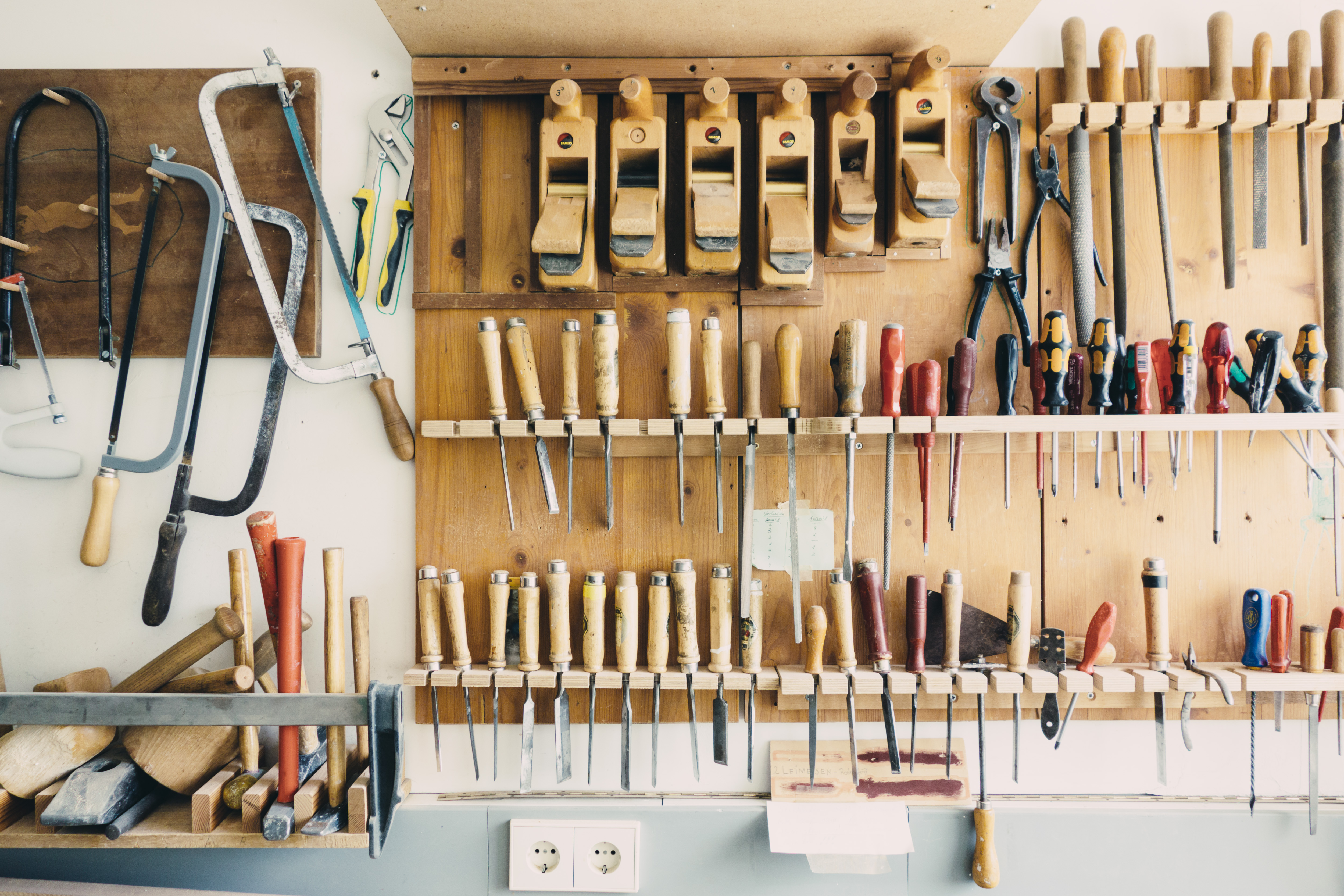
Linking furniture to household order is easier with a coherent storage system — pair this guide with the article on storage in small spaces, where you plan containers and labels alongside building the drawers.
In summary: in a Singapore HDB, DIY furniture makes financial sense (savings of thousands of dollars on large pieces), functional sense (dimensions matched exactly to your plan), and technical sense — with a conscious choice of moisture-resistant materials, pieces last for years without delaminating edges. Start with one project (e.g. a wall-mounted table), master cutting and hardware, then move on to a bed with drawers; that way you avoid costly material mistakes and adapt the flat to life in a compact space without giving up comfort.